Chapter 07 · September 1929 onwards
After
the silence
A death in a Lahore prison cell became, within a week, one of the largest public events in the history of Bengal. This chapter follows what happened to the argument Jatin Das had been making once he was no longer alive to make it.
The journey from Lahore
His body was not quietly disposed of. It was released to his family and carried by train from Lahore across northern India to Calcutta — a journey of roughly two days through the most densely populated part of the subcontinent, in September 1929, with the newspapers full of him.
The party accompanying the coffin included Durgawati Devi — known in the revolutionary movement as Durga Bhabhi — together with Sardar Kishan Singh, the father of Bhagat Singh, and Kiron Das, Jatindra's younger brother, who had been with him when he died. Accounts record people gathering at stations along the route to see the train pass.
At Howrah station in Calcutta the coffin was received by Subhas Chandra Bose, then one of the dominant figures of Bengali politics, accompanied by Basanti Devi, Kamala Nehru, Dr B. C. Roy, Shyama Prasad Mookerjee and Maulvi Shamsuddin. The bier was carried by a group that included Dr Gopi Chand Bhargava, Dr Muhammad Alam, Dr Saifuddin Kitchlew, Sardar Sardul Singh Caveeshar, Dr Benarasi Das, Sardar Kishan Singh and Lala Duni Chand — a list worth reading slowly, because it crosses every communal and factional line in Indian politics at the time.
The funeral procession through Calcutta to the cremation ground is described in the accounts as roughly two miles long. Attendance is very widely reported as more than five lakh — over five hundred thousand people. This archive reproduces that figure as what the sources say rather than as a verified count: crowd estimates from 1929 were not made by any systematic method, and no contemporaneous enumeration has been located. What is not in doubt is that the funeral was among the largest public gatherings Bengal had seen.
What his death actually changed
In the legislatures. Motilal Nehru moved for the adjournment of the Central Legislative Assembly as a censure of the treatment of the Lahore prisoners. The motion was carried against the government by 55 votes to 47 — a defeat inflicted on the colonial executive by the body it had itself constituted. In the Punjab Legislative Council, Mohammad Alam and Gopi Chand Bhargava resigned their seats in protest.
In prison policy. The government appointed a jail enquiry committee in the Punjab in late 1929. The remaining hunger strikers suspended their protest on assurances from the committee's members that the question of the treatment of political prisoners would be settled to their satisfaction; the same assurance was given publicly in the Assembly by Sir James Crerar. The strike as a whole had run about 116 days.
In the government's own conduct. The historian Kama Maclean has observed that the impact of the photograph The Tribune printed on its front page of 15 September 1929 was such that the British afterwards ceased handing over the bodies of revolutionaries to their families — a change visible two years later in the disposal of the bodies of Bhagat Singh, Sukhdev and Rajguru.
Another name has been added to the long and splendid roll of Indian martyrs. Let us bow our heads and pray for strength to act to carry on the struggle, however long it may be and whatever the consequences, till the victory is ours.
Jawaharlal Nehru, September 1929There are qualities which compel admiration of all men alike and the prominent among them are qualities of courage and constancy in pursuit of an ideal.
Carden Noad, counsel for the prosecution, Lahore Conspiracy CaseThe “young Dadhichi”
Subhas Chandra Bose is recorded as describing Das as the “young Dadhichi” of India — a reference to the sage of Hindu tradition who gave up his own body so that his bones could be made into a weapon against injustice. The phrase became one of the standard ways of speaking about him.
Bhagat Singh and Jatin Das
in historical memory
The two men are remembered together, and the reason is historical rather than sentimental: they were members of the same organisation, prosecuted in the same case, imprisoned in the same city, and engaged in the same protest. Bhagat Singh and Batukeshwar Dutt began the hunger strike on 15 June 1929; Das joined it on 13 July and died on it; Bhagat Singh's father travelled with Das's body towards Calcutta; Bhagat Singh himself was executed eighteen months later, on 23 March 1931.
Their afterlives, however, have been very different. Bhagat Singh became one of the most widely commemorated figures in modern India, claimed across the political spectrum. Das occupies a smaller and quieter place — a name attached to a park and a metro station in Kolkata, a postage stamp, a paragraph in school textbooks. Part of the reason is that his act was undramatic. Nothing exploded. He simply refused, for sixty-three days, and the refusal is harder to put on a poster than a rifle or a gallows.
It is worth resisting the version of this story in which Das exists mainly as an episode in Bhagat Singh's biography. The demand he died over was his own long before Lahore: he had made it, in the same way, at Mymensingh in 1925, when Bhagat Singh was still a teenager in the Punjab. Popular retellings that dramatise conversations between the two men — in films, novels and online — are inventions. This archive does not reproduce them.
How he is remembered
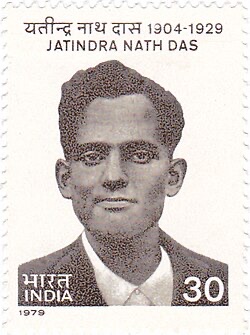
1979
A national postage stamp
India Post issued a commemorative stamp bearing his portrait and the dates 1904–1929 — the state that had once been the colonial administration's successor formally inscribing him into the national record. It is reproduced alongside.
—
Jatin Das Park, Kolkata
A public park in south Kolkata carries his name, as does the Jatin Das Park station on the Kolkata Metro — so that a commuter in the city where he was born passes his name daily without necessarily knowing the story attached to it.
2002
On screen
He appears as a character in the film The Legend of Bhagat Singh, played by Amitabh Bhattacharjee, and is the subject of a thirty-five-minute documentary, Immortal Martyr Jatin Das, released in 2009.
Why Jatin Das still matters
Because the question he raised has not been closed. How a state treats the people it imprisons for political reasons remains a live question in many countries, including democratic ones. Das's argument — that motive is relevant to classification, and that a government which claims legitimacy cannot place its opponents outside the reach of ordinary decency — is not a period curiosity.
Because of what he was asking for. The demands were modest to the point of banality: edible food, clean clothing, exemption from degrading labour, the company of one's fellows, books and a newspaper. That a young man died over a list like that says something exact about the conditions he was describing.
Because he was young, and ordinary. He was twenty-four, a first-division student who never finished his degree, from a family about which we know almost nothing. He is not remembered for genius or for command. He is remembered for persistence.
Because his method was refusal. Of all the acts associated with the revolutionary movement, his required no weapon and injured no one but himself. It belongs as much to the history of civil resistance as to the history of armed nationalism — and that ambiguity is part of why he sits a little awkwardly in both traditions.
Because of what his death made visible. A prison is designed to be unobservable. For sixty-three days in 1929 the inside of one became the most closely watched place in India, and a colonial government lost a vote in its own legislature over what was happening there.
And because the record is so thin. We do not have his words. We do not know what he thought on the fortieth day. That absence is itself instructive: it is what the historical record usually looks like for people who are not powerful, and it is a reason to read every confident, detailed retelling of his inner life with suspicion.
Sources for this page
- 01“Jatindra Nath Das”, Wikipedia — the journey of the body from Lahore, Durgawati Devi, Sardar Kishan Singh and Kiron Das, the reception at Howrah by Subhas Chandra Bose and others, the bearers of the bier, the two-mile procession, the reported figure of more than five lakh, the Assembly censure motion carried 55–47, the Punjab Legislative Council resignations, the 1979 stamp, Jatin Das Park metro station, the “young Dadhichi” description, and the Nehru and Carden Noad quotations. en.wikipedia.org
- 02“The Tribune photo on Jatin Das shook British empire”, The Tribune (Chandigarh) — the front page of 15 September 1929, the photo essay “Lahore's Tribute to Jatin” of 17 September 1929, and Kama Maclean's assessment. tribuneindia.com
- 03“Bhagat Singh”, Encyclopædia Britannica — the executions of 23 March 1931. britannica.com